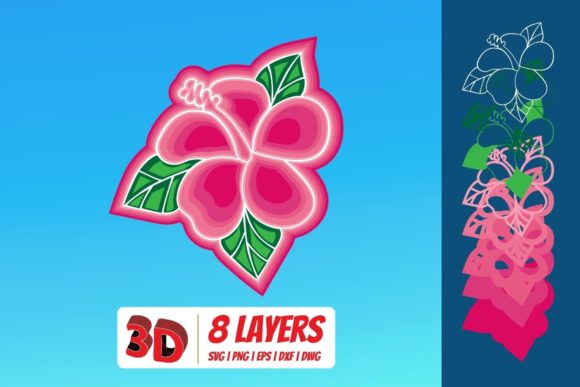
3D Hibiscus SVG as a Strategic Asset in Modern Design
In the landscape of digital design, few elements carry the visual weight and symbolic resonance of the hibiscus. When rendered as a 3D SVG, this tropical bloom becomes more than a static graphic — it transforms into a versatile asset that can support branding, communication, creative workflow, and long-term positioning. Understanding what a 3D Hibiscus SVG is and how to deploy it thoughtfully can help you make better decisions about your visual toolkit, whether you are developing a product line, refining a website, or building a cohesive brand identity.
What Makes a 3D Hibiscus SVG Strategically Useful
A 3D Hibiscus SVG is a scalable vector graphic that simulates three-dimensional depth while retaining the crispness and flexibility of SVG format. Unlike raster images, it scales infinitely without loss of quality, and unlike flat vectors, it introduces shading, highlights, and curvature that mimic real-world form. This combination makes it uniquely suited for contexts where both precision and visual impact matter.
From a strategic standpoint, the value lies in the way a 3D Hibiscus SVG can convey depth, texture, and a sense of realism without the weight of a photograph. It loads quickly, integrates cleanly into responsive layouts, and can be styled or animated with CSS. For entrepreneurs and creators who need to communicate a polished, professional image, this format offers a bridge between flat illustration and full 3D rendering — without the complexity or performance cost of the latter.
When you consider the goals of brand positioning, customer experience, and operational efficiency, the 3D Hibiscus SVG becomes a tool that supports multiple objectives at once. It reduces dependency on heavy image files, speeds up page load times, and gives you a graphic that feels contemporary and crafted. For small businesses and publishers operating on lean budgets, that kind of multifaceted asset is worth evaluating.
Using 3D Hibiscus SVG to Support Brand Identity and Communication
Brand communication depends on consistency and recognition. A 3D Hibiscus SVG can serve as a signature visual element across platforms — from hero images on a landing page to icons in an email campaign. Because it is vector-based, it can be resized for a favicon, a social media post, or a print brochure without degrading. This flexibility allows you to maintain a cohesive look without maintaining multiple file versions.
In practice, consider a lifestyle brand focused on tropical wellness or resort wear. A flat hibiscus icon may feel generic, but a 3D version introduces a layer of sophistication that suggests attention to detail. The subtle shadows and contours signal quality — a perception that transfers to the brand itself. For marketers and decision-makers, this is not about decoration; it is about using design elements to shape how an audience perceives value.
Beyond branding, the 3D Hibiscus SVG can improve communication clarity. In educational materials or how-to guides, a dimensional flower helps viewers quickly identify a specific plant or part of a botanical diagram. For creators producing tutorials or infographics, the added depth reduces ambiguity and speeds up comprehension. When your goal is to inform or instruct, every visual cue that reduces cognitive load contributes to a better user experience.
Planning Your Approach: When to Incorporate 3D Hibiscus SVG
Like any design asset, a 3D Hibiscus SVG delivers best when used with intention. Before integrating it into a project, assess the context and the message you want to reinforce. If your brand voice is minimal and modern, a single 3D hibiscus used as a focal point can create contrast and draw attention. If your aesthetic is lush and layered, multiple variations can build a rich visual environment without overwhelming the viewer.
Timing also matters. During a product launch or website redesign, a 3D Hibiscus SVG can anchor the visual direction and set the tone for supporting graphics. For ongoing content creation, consider building a small library of hibiscus variations — different angles, lighting conditions, or color palettes — so that you maintain variety without starting from scratch each time. This kind of planning reduces production bottlenecks and keeps your creative output consistent.
Another practical consideration is accessibility. Because SVG elements can be tagged with descriptive alt text, a 3D Hibiscus SVG can be made accessible to screen readers in ways that complex raster images cannot. For publishers and educators committed to inclusive design, this is a meaningful advantage. Planning for accessibility from the outset ensures that your visual choices do not exclude segments of your audience.
Creativity and Productivity Gains Through Intentional Use
One of the less obvious benefits of using a 3D Hibiscus SVG is the effect it can have on your own creative process. When you work with an asset that already contains depth and lighting cues, you spend less time building those elements from scratch. Instead, you can focus on composition, placement, and interaction. For freelancers and small teams, this translates directly into productivity gains — less time per asset, more time for strategic thinking.
Consider a social media manager who needs to produce a series of tropical-themed posts. With a library of 3D Hibiscus SVGs, the production pipeline becomes simpler: select a base graphic, adjust the styling to match the campaign palette, and place it in the layout. The dimensional quality does the heavy lifting of making each post feel polished. Over the course of a quarter, that efficiency frees up hours that can be redirected toward audience analysis or content strategy.
For educators and curriculum developers, a 3D Hibiscus SVG can serve as a reusable teaching tool. Instead of sourcing a new image for every lesson on pollination or plant anatomy, you have a consistent, high-quality graphic that students can study across multiple sessions. This consistency supports learning outcomes by reducing visual variability and reinforcing pattern recognition.
What to Consider Before Relying on a 3D Hibiscus SVG
Despite its advantages, a 3D Hibiscus SVG is not a solution for every situation. One risk is overuse. When every page or product features the same dimensional bloom, the effect loses impact and may even feel repetitive. Strategic use means limiting the asset to key touchpoints where it can make a difference, rather than scattering it across every available space.
Another consideration is the aesthetic context. A 3D graphic with realistic shading may clash with a deliberately flat or minimalist design system. In such cases, the depth can feel out of place rather than enhancing. Before committing, test the 3D Hibiscus SVG against your existing visual hierarchy. If it draws attention away from primary content or competes with core calls to action, it may need to be modified or reserved for less critical areas.
Technical compatibility also warrants attention. While SVGs are widely supported, certain advanced 3D effects may rely on CSS filters or JavaScript libraries that older browsers handle inconsistently. If your audience includes users on legacy systems, test the rendering across devices and browsers. A graphic that fails to load or displays incorrectly undermines the very professionalism you are trying to project.
Practical Examples of 3D Hibiscus SVG in Real-World Contexts
To ground the discussion, here are a few concrete scenarios where a 3D Hibiscus SVG can deliver measurable results:
- E-commerce product badges. An online retailer selling tropical-themed home decor uses a small 3D Hibiscus SVG as a badge for sale items. The dimensional graphic catches the eye without overpowering the product photos, and the SVG format keeps the badge crisp on retina displays.
- Educational interactive diagrams. A biology educator builds an interactive plant anatomy module where a 3D Hibiscus SVG responds to mouse hover, revealing labeled parts. Students engage longer with the content, and the vector format allows the diagram to scale for classroom projection or mobile study.
- Brand email signatures. A travel agency includes a subtle 3D Hibiscus SVG in its email signatures. The graphic loads instantly, renders consistently across email clients, and reinforces the brand’s connection to tropical destinations without relying on bulky images.
- Website hero sections. A wellness blog uses a large 3D Hibiscus SVG as the hero background on its homepage. The depth creates a sense of calm and immersion, while the SVG remains lightweight and responsive. The blog sees a measurable improvement in time-on-page as visitors pause to take in the visual.
Each of these examples shares a common thread: the 3D Hibiscus SVG is used to fulfill a specific function — highlighting, teaching, branding, or engaging — rather than as arbitrary decoration. The decision to use it is tied to a goal.
Long-Term Value and Avoiding Random Deployment
The most significant risk of using a 3D Hibiscus SVG without clear goals is dilution of its impact. When an asset appears without intention, it becomes noise. Over time, audiences learn to ignore it, and the potential for building recognition or conveying quality is lost. To avoid this, treat each deployment as part of a broader visual strategy. Ask: Does this graphic serve the message? Does it improve the user experience? Does it reinforce the brand identity?
Long-term value also depends on maintaining consistency. If you plan to use multiple 3D Hibiscus SVGs across seasons or campaigns, define guidelines for color, lighting, and scale. A set of standards ensures that assets from different production cycles still feel like part of the same family. For teams and agencies, these guidelines reduce revision cycles and keep the visual language coherent as new contributors join the work.
Finally, consider the lifespan of your assets. A well-crafted 3D Hibiscus SVG, designed with timeless aesthetics rather than trends, can serve your brand for years. Investing in quality at the outset — whether by creating your own asset or sourcing from a reputable provider — pays dividends every time you reuse it. For small business owners and solo creators, that kind of durability is a smart allocation of limited resources.
Making Better Decisions with 3D Hibiscus SVG
At its best, a 3D Hibiscus SVG is not just a graphic — it is a decision-making tool. It forces you to clarify what you want your visual identity to say, how much complexity your audience can absorb, and where a single well-placed element can carry more weight than a dozen generic images. By approaching it with the same rigor you apply to budgeting, product development, or content planning, you ensure that your design choices support your broader objectives rather than undermining them.
For marketers, creators, educators, and decision-makers alike, the question is not whether a 3D Hibiscus SVG looks good. It is whether it helps you achieve what you set out to do. When the answer is yes, and the usage is intentional, the asset becomes a small but meaningful lever for better outcomes — faster load times, clearer communication, stronger branding, and a more cohesive experience for everyone who interacts with your work.