3D Watering Can SVG: A Versatile Design Resource
When you come across a 3D Watering Can SVG, you might see it simply as a graphic file. But for designers, crafters, educators, and small business owners, this particular asset can open up a surprising range of practical possibilities. Whether you are building a brand identity for a garden center, creating educational materials about plant care, or designing custom merchandise for a spring event, a well-crafted 3D Watering Can SVG offers depth and realism that flat icons often lack. Understanding what this resource is, how it works, and where it fits best can help you make smarter creative decisions and save time on projects that demand visual impact.
What Makes a 3D Watering Can SVG Different from Standard Graphics
Scalable Vector Graphics, or SVGs, are widely used because they maintain crispness at any size. A 3D Watering Can SVG takes this a step further by incorporating shading, perspective, and dimensionality that mimic real-world objects. Unlike a simple line drawing or flat silhouette, a 3D version includes highlights, shadows, and rounded forms that give the watering can a tangible presence. This makes it especially effective for mockups, product previews, and any setting where you want the viewer to feel as though they could reach out and pick up the can.
The technical advantage is that SVGs are resolution-independent, so zooming in for a large banner or shrinking the graphic for a business card will not cause pixelation. A 3D Watering Can SVG retains its detail and depth regardless of scale, which is one of the main reasons designers choose vector formats for professional work. You can also edit the colors, gradients, and individual elements within the SVG using vector editing software, giving you control over how the final image looks without starting from scratch.
Who Benefits Most from Using a 3D Watering Can SVG
Different audiences can leverage this graphic in distinct ways. Freelance designers and graphic artists often use a 3D Watering Can SVG as a base element in larger compositions. Instead of spending hours creating realistic shading from scratch, they can import the SVG and adjust it to match a specific color palette or lighting style. This speeds up project timelines and allows them to accept more work or focus on higher-level creative decisions.
Small business owners, especially those in gardening, landscaping, or home improvement, can incorporate a 3D Watering Can SVG into logos, social media posts, packaging, and website headers. The three-dimensional look conveys a sense of quality and attention to detail, which can help differentiate a brand from competitors who rely on generic clip art. For entrepreneurs who handle marketing themselves, having access to a ready-made professional graphic reduces the need to hire an outside designer.
Educators and content creators also find value in a 3D Watering Can SVG. Teachers preparing science or nature lessons can use the image in worksheets, slideshows, or interactive digital activities. Bloggers writing about gardening tips, plant care, or sustainable living can insert the SVG to break up text and add visual interest. In each case, the 3D effect makes the content more engaging without requiring advanced illustration skills.
Practical Benefits for Design Projects and Workflows
One of the most practical benefits of using a 3D Watering Can SVG is how it simplifies the decision-making process around visuals. When you are designing a flyer for a plant sale or a social media post about watering schedules, you do not need to debate whether a photograph or a hand-drawn illustration will work better. A 3D SVG sits in a middle ground that feels both professional and approachable. It is detailed enough to look polished but stylized enough to fit alongside other vector elements.
Time savings are another key advantage. Because SVGs are lightweight and easy to manipulate, you can resize, recolor, or rotate a 3D Watering Can SVG in seconds. In contrast, editing a 3D rendering from a modeling application often requires exporting, re-rendering, or adjusting complex parameters. For marketing teams working under tight deadlines, the ability to tweak a graphic quickly without losing quality is a real productivity booster.
Consistency across materials also improves. If you use the same 3D Watering Can SVG on your website, in an email newsletter, and on a printed brochure, the branding stays uniform. The SVG format ensures that colors and proportions remain accurate across different media, which is harder to achieve with raster images that can shift or degrade during conversion.
Realistic Use Cases in Marketing and Branding
A local nursery that sells plants and gardening tools might use a 3D Watering Can SVG as the centerpiece of its logo. The depth of the graphic communicates a hands-on connection to the products, while the vector format keeps the logo sharp on everything from store signage to mobile apps. The same nursery could then use variations of the SVG for promotional banners, product labels, and social media templates. Having one source file that can be adapted for multiple purposes eliminates the need to create new assets from scratch each time.
For a freelance designer working on a gardening blog redesign, the 3D Watering Can SVG can serve as a repeating motif. It might appear in the header, as a bullet point icon, or as part of an illustration for a watering guide. The consistency of the 3D style ties the design together and gives it a cohesive feel that flat icons might not achieve.
Creative Possibilities Beyond Standard Use
A 3D Watering Can SVG also opens the door to more creative applications that go beyond simple placement. You can combine it with other SVG elements to build scenes, such as a garden setting with pots, plants, and tools. Because the watering can has a recognizable shape and depth, it anchors the scene and makes the composition feel grounded. Designers often use this approach for landing pages, seasonal promotions, or educational infographics.
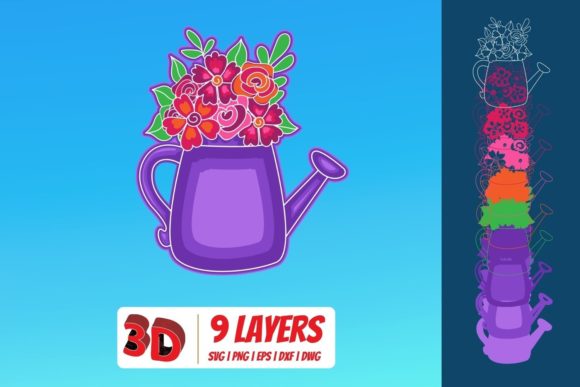
Another creative direction involves using the SVG as a starting point for digital crafting. Hobbyists who work with cutting machines, such as Cricut or Silhouette, can import a 3D Watering Can SVG and use it to create layered paper projects, vinyl decals, or iron-on transfers for t-shirts and tote bags. The 3D effect translates well into physical materials when you separate the highlights and shadows into different cut layers. This allows for dimensional crafts that stand out from standard flat designs.
Marketers and content creators can also animate the SVG for digital use. With a little vector editing and CSS or JavaScript, a 3D Watering Can SVG can be made to tilt, sway, or appear to pour water. Animated graphics attract attention in social media feeds and email headers without the file size overhead of video. This kind of subtle motion can boost engagement while keeping the look clean and professional.
Limitations and Considerations When Choosing a 3D Watering Can SVG
Even with its many strengths, a 3D Watering Can SVG is not the perfect fit for every project. If you need a photorealistic image for a high-end print catalog, a vector graphic with stylized shading may not match the level of detail required. In those cases, a photograph or a full 3D render from a modeling program might serve you better. Understanding the difference between stylized 3D and photorealism helps you choose the right tool for the job.
Another consideration is the learning curve for editing SVGs. While many designers are comfortable with vector software like Adobe Illustrator or Inkscape, beginners may find the process unfamiliar. If you are new to working with vectors, you might need to spend a little time learning how to adjust layers, gradients, and anchor points. However, the investment pays off once you see how much control you have over the final appearance.
File quality also varies depending on the source. A well-constructed 3D Watering Can SVG will have clean geometry, properly grouped layers, and thoughtful use of gradients. A poorly made one might have overlapping shapes or excessive nodes that make editing difficult. When selecting an SVG, look for files that include separate layers for shadows, highlights, and the main body. This makes customization much easier and preserves the 3D effect during edits.
How to Integrate a 3D Watering Can SVG into Your Workflow
Start by identifying where the graphic will have the most impact. If you are designing a website hero section, consider placing the 3D Watering Can SVG alongside a headline and call-to-action button. The depth of the image draws the eye, so surround it with breathing room and minimal clutter. For print materials, test the SVG at the final output size to ensure the shading reads well at that scale.
If you plan to use the SVG across multiple platforms, create a master version with the colors and gradients you prefer, then export copies in the formats you need. Most vector software allows you to export SVGs, PNGs, and PDFs from the same file. This gives you a high-quality master copy and platform-specific versions that load quickly and display correctly.
For those selling products or services related to gardening, home design, or sustainable living, a 3D Watering Can SVG can become a signature element in your visual identity. Using it consistently across your website, social media, and packaging builds recognition and trust with your audience. Over time, customers will associate that distinctive three-dimensional graphic with your brand’s commitment to quality and care.
Ultimately, a 3D Watering Can SVG is more than just a decorative image. It is a practical tool that supports creativity, saves editing time, and strengthens communication across a wide range of projects. Whether you are a seasoned designer looking for a reliable base asset or a small business owner seeking professional visuals without a large budget, this versatile graphic offers real value that goes well beyond its simple appearance.